
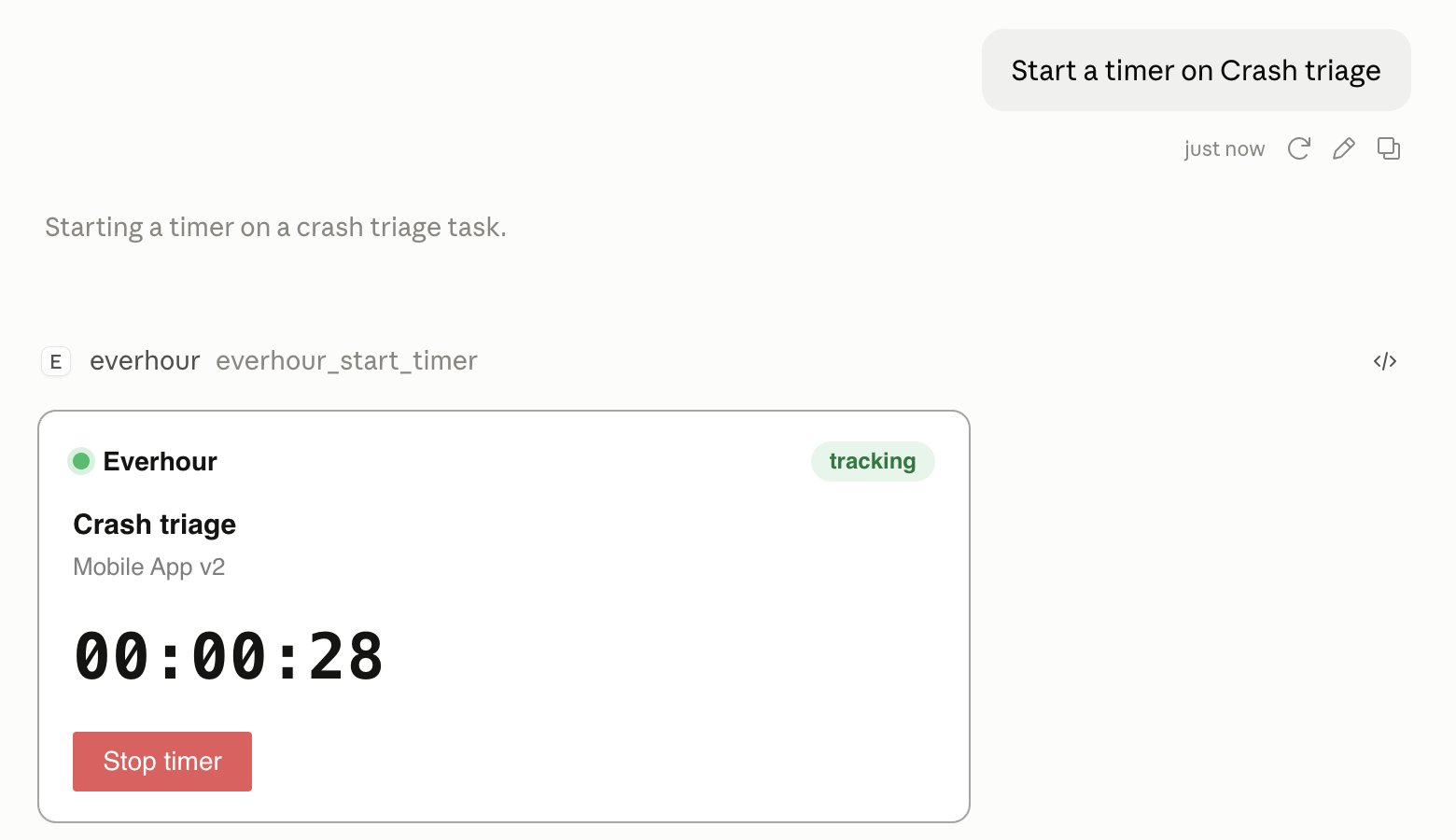
Ask for a timer and you get a running clock with a Stop button.
What you can ask for
- Your timer — start one on a task, start one without a task, stop it, or check what’s running.
- Your time — log time to a task, fix a duration you got wrong, or clear an entry you put in the wrong place.
- Your timesheet — this week with daily totals, or any month of raw entries.
- Your tasks — search by keyword, see what you tracked recently, open one task in detail, or pin the ones you return to.
- Your projects, clients, and team — look up a project, a client, or who’s on the team.
- Team reports — hours by project or member, project budgets, who’s on time off, and weekly capacity, as far as your role allows.
Set up Everhour in Claude
You need an active Everhour account. There’s nothing to set up in Everhour first — no app to create and no key to copy, and nothing to pay: connecting an assistant is included in every Everhour plan at no extra cost. Add Everhour as a custom connector, sign in when your browser opens, and switch it on in your chat. It works the same in Claude on the web, in the desktop app, and in the mobile apps.On a Team or Enterprise plan, only an Owner can add a connector. If that’s not you, you don’t need to do the setup — ask your Owner to add Everhour once, then open Customize → Connectors and click Connect. On Free, Pro, and Max you add it yourself.
Claude on the web and desktop
The setup, click by click — including what to do if you’re not an admin.
Claude Code
One command, then authorize in the browser.
Interactive cards
In Claude, some answers come back as a card you can actually use, not just text. Ask about your timer and you get a running clock with a Stop button. Ask for your tasks and you get a list where each row starts a timer. There are four:- Timer — the running task, elapsed time, and a Stop button. Appears when you ask what you’re tracking, or when you start or stop a timer.
- Task list — recent tasks, search results, or your favorites. Every row has a start button and a chevron that opens the full task; rows in the favorites list also carry a star.
- Task card — one task with its project, assignees, estimate, status, tags, and your time on it. You can start the timer, add time, or star it without leaving the card.
- Timesheet — a month grid or a week list, switchable, with daily and weekly totals. In the month grid, click a day to see the entries behind it.
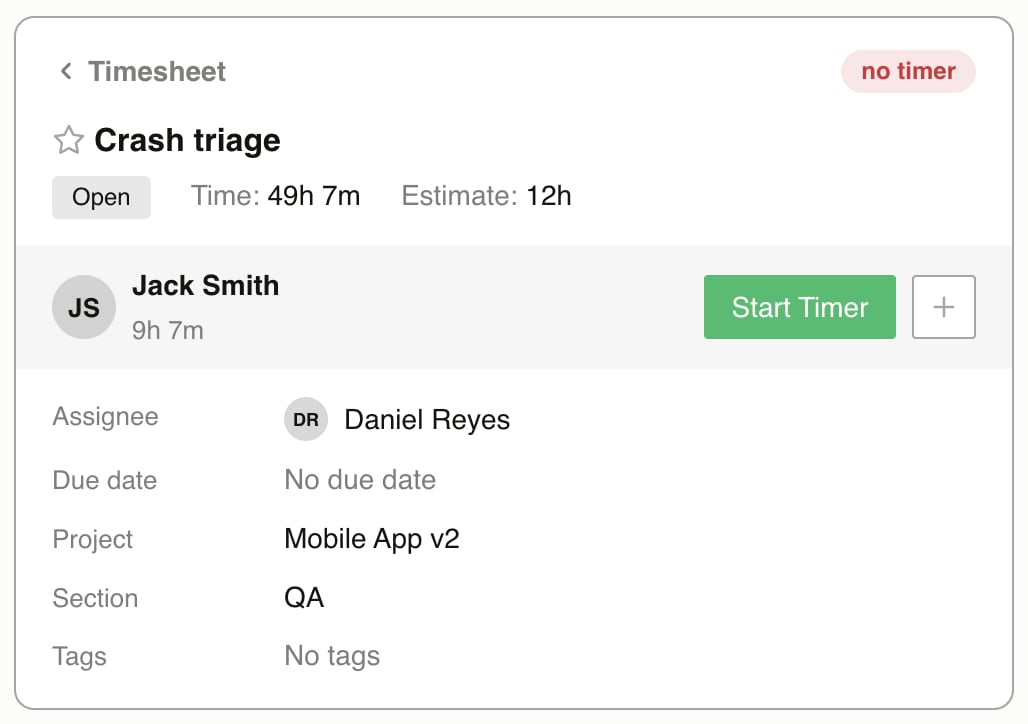
Open a task from any row and you get its status, totals, and fields — plus Start Timer and + to add time without leaving the card.
- Month
- Week
- One day
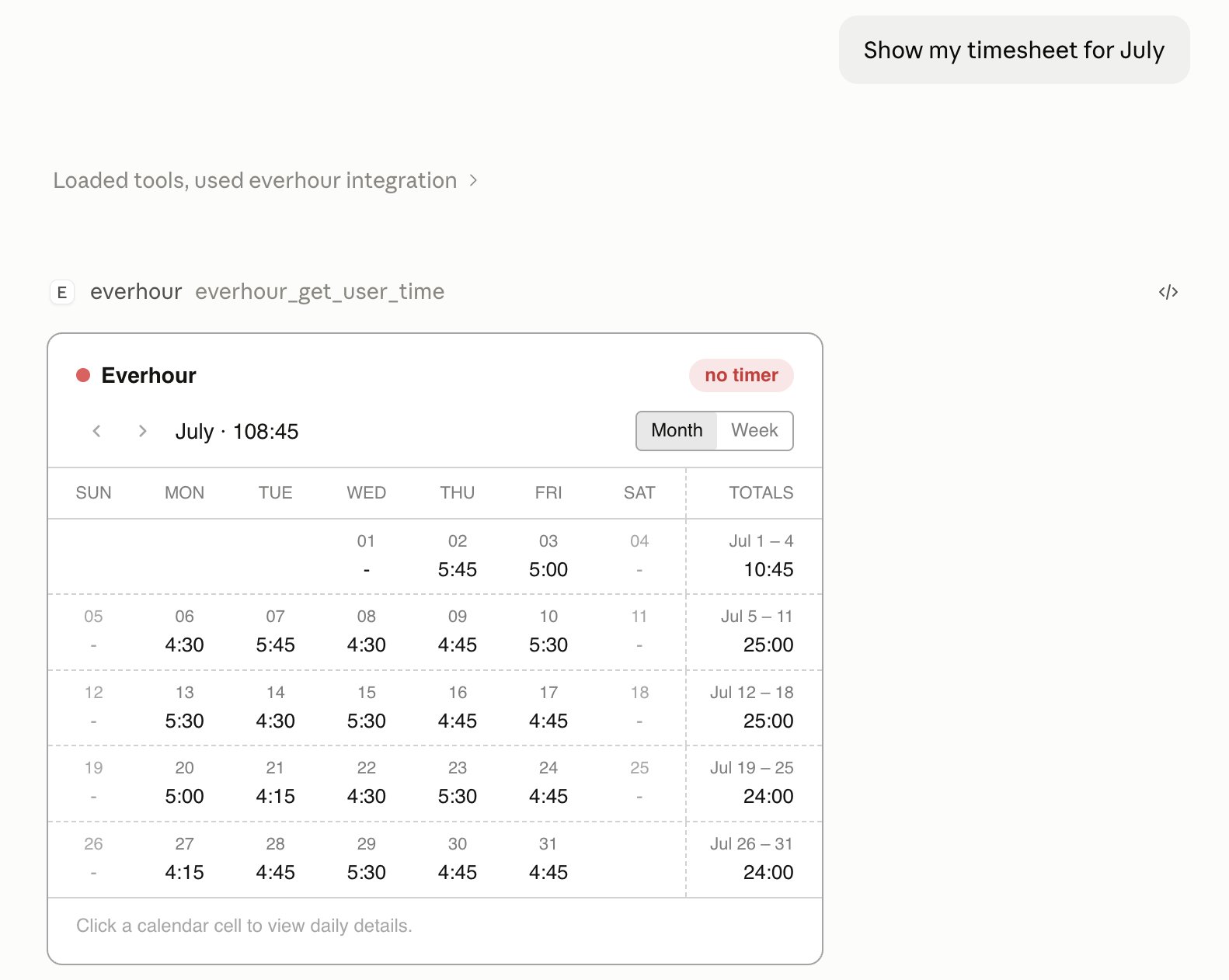
The month grid, with a figure for every day and a total for every week.
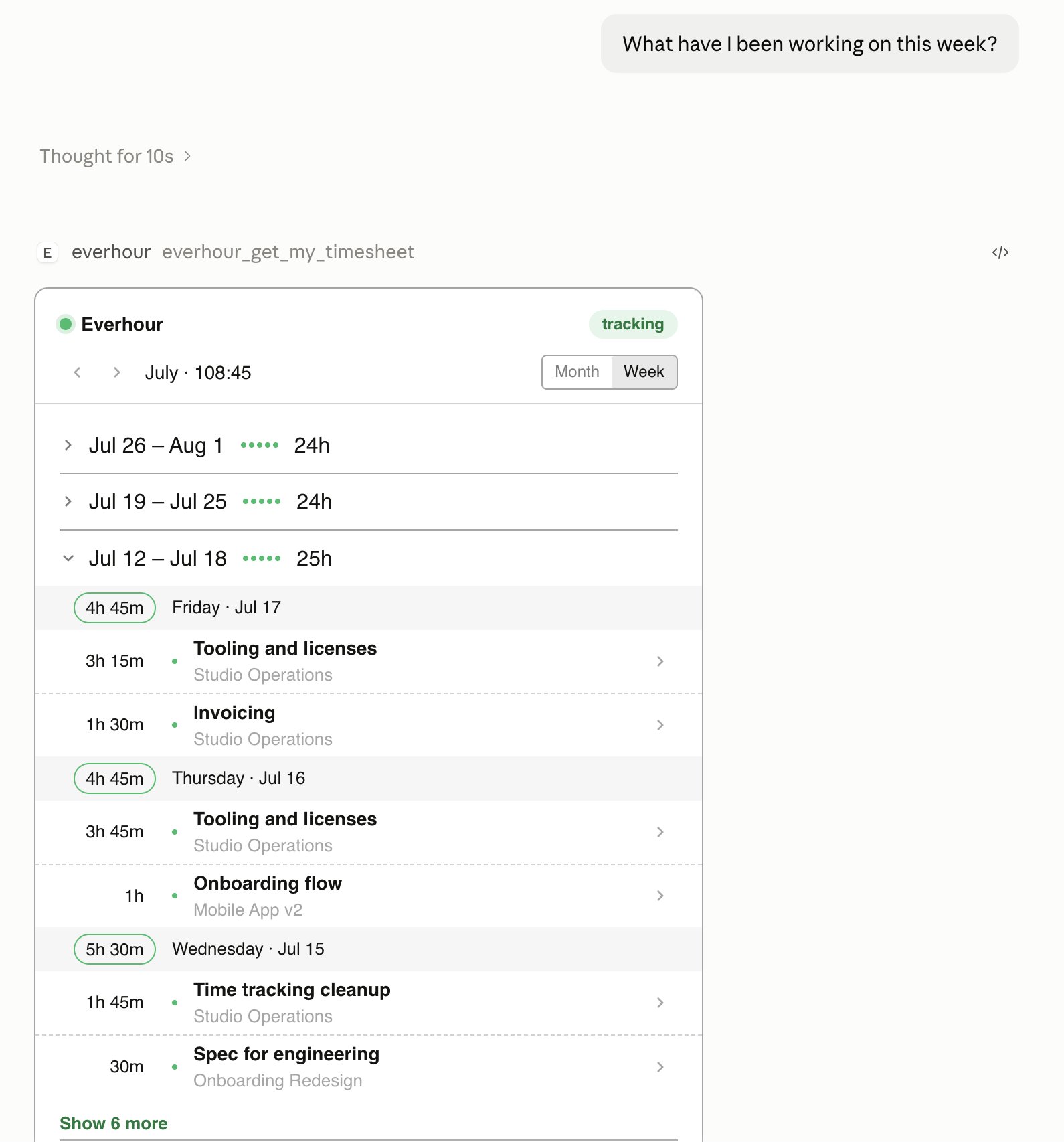
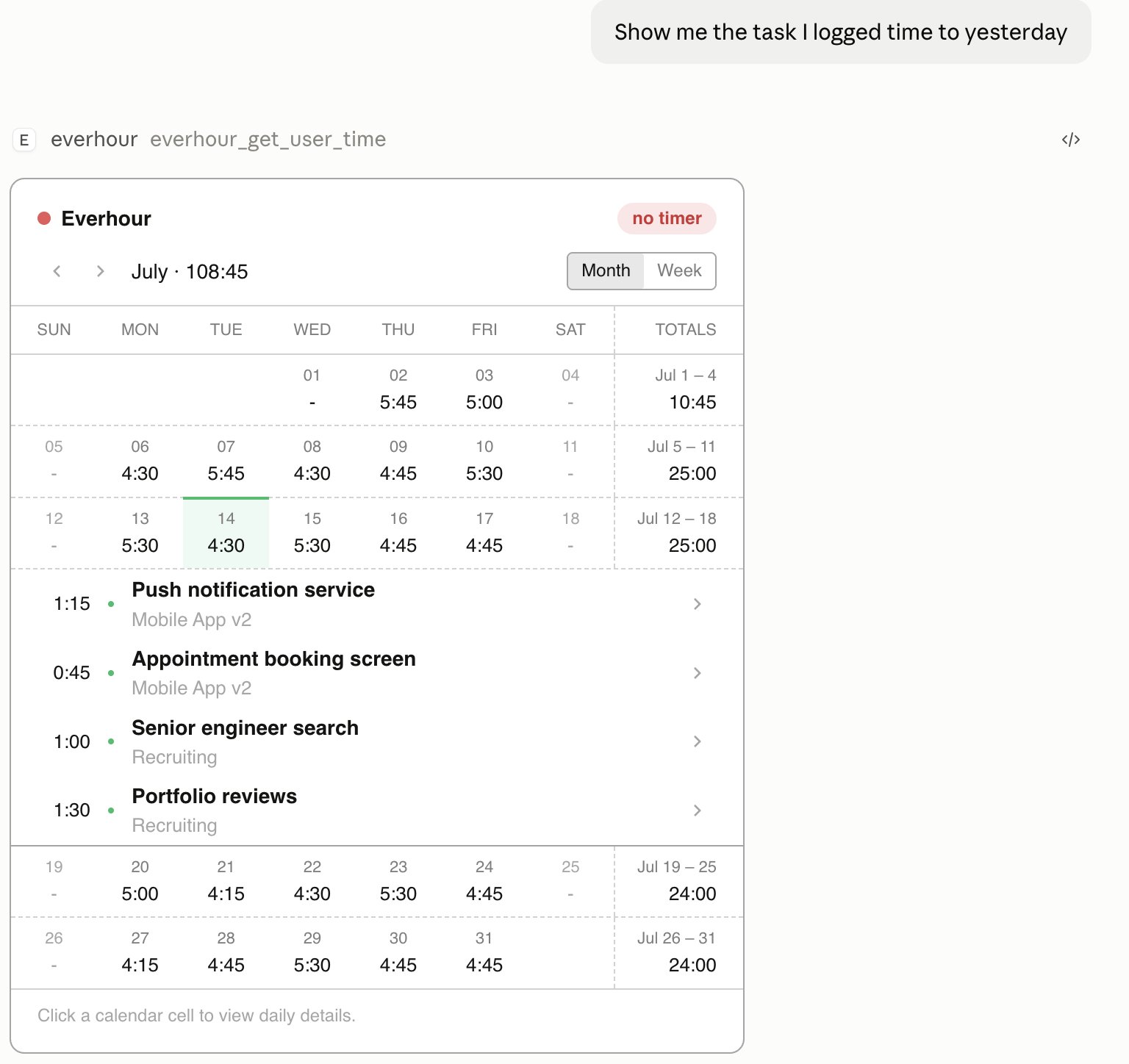
Cards appear in the Claude apps that can draw them. Anywhere they can’t, the same answer arrives as plain text with nothing left out.
Example prompts
Phrase things however you like — these are just starting points. Tracking right now- “Start a timer on the login bug.”
- “What am I tracking?”
- “Stop my timer.”
- “Start a timer for the standup — I’m not on a task.”
- “Log 2 hours to the API docs task.”
- “I forgot to track yesterday — put 3 hours on the checkout redesign for Tuesday.”
- “Change yesterday’s design entry to 90 minutes.”
- “I logged that to the wrong task, clear it.”
Clearing sets the time to zero rather than deleting the row — the task keeps a 0-hour line on your timesheet. To move the time somewhere else, ask Claude to change the entry to the right task instead of clearing it. Why it works that way.
- “Show my timesheet for this week.”
- “How much did I track in April?”
- “Which project got most of my time last month?”
- “Find tasks about onboarding.”
- “What have I worked on recently?”
- “Track time on this Asana link.” (paste the URL)
- “Pin the checkout task to my favorites.”
- “How many hours did the team log by project last month?”
- “Which projects are over budget?”
- “Who’s out on time off next week?”
Permissions and privacy
- You approve the connection once. Signing in happens on Everhour, in your browser. Claude never sees your password.
- Claude acts as you, and only as you. It can do exactly what your Everhour role allows — a member can’t read the team’s payroll through Claude any more than through the web app.
- Claude asks before it changes anything. The tools that write to your account are marked as such, and Claude prompts you to confirm each time.
- Everhour doesn’t see your conversation. We receive the details of the actions Claude takes — a task, a duration, a date, a comment, a search term — and nothing else. What you type to Claude stays between you and Claude; it never reaches Everhour.
If something isn’t working
Claude says it can't find Everhour
Claude says it can't find Everhour
Check that Everhour is switched on for this conversation — click + at the lower left of the chat box and look under Connectors. Connectors are enabled per chat, so one you added earlier may be off in a new conversation.
A report shows 0 where you expected money
A report shows 0 where you expected money
That’s a permissions boundary, not a figure. Cost and billing columns you’re not allowed to see come back as
0 — see Data, privacy, and permissions.Claude asks you to confirm every time
Claude asks you to confirm every time
That’s the destructive hint doing its job — the tools that change your data always prompt. The rest read only and run without asking. Which ones.